
Seven Centimeters Too Short for the Sky, and Still She Dances Tango Milonga
on Letters to the Ones I Never Met by Pinar Wennerberg, PhD

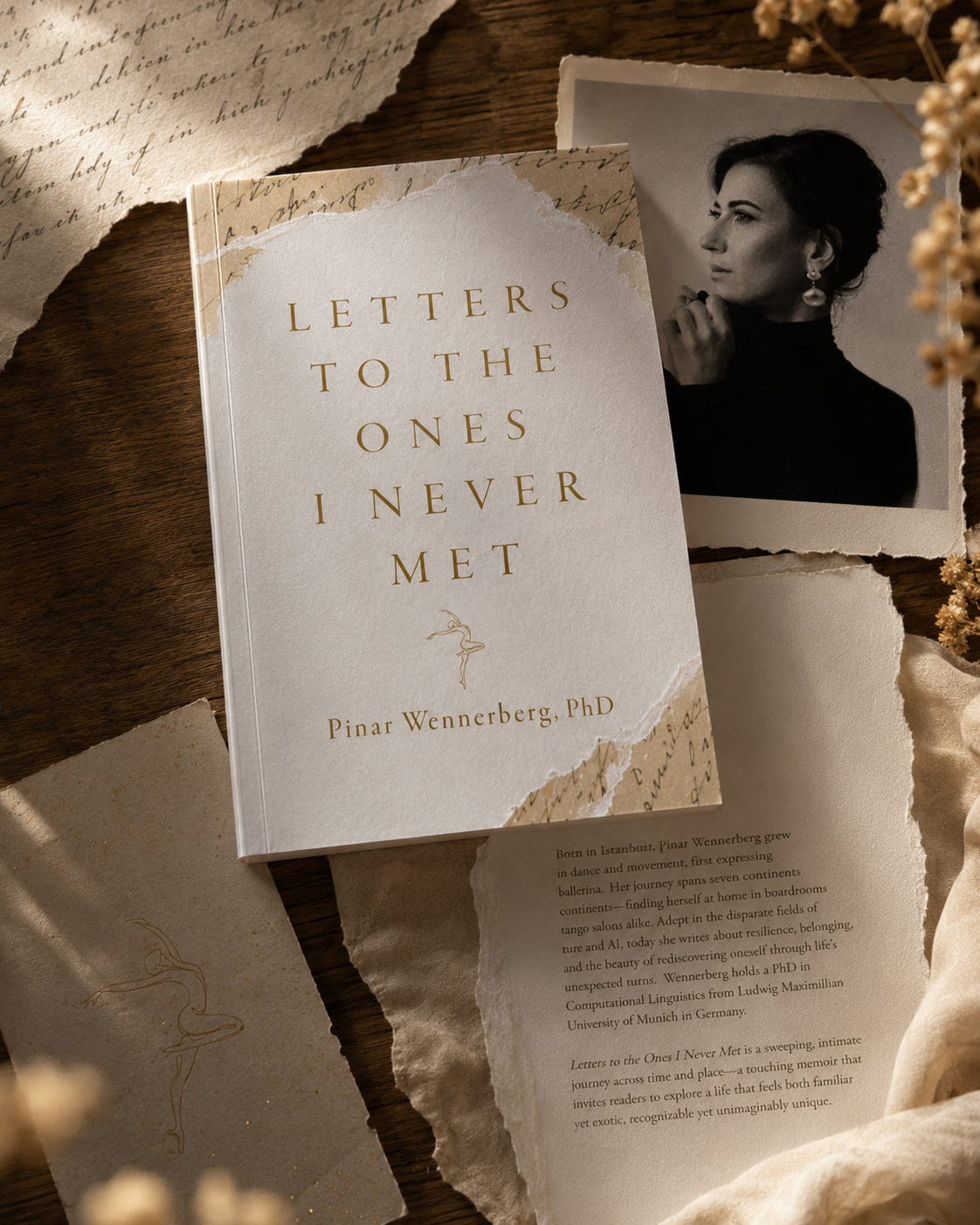
I did not cry at the bread. I want to be exact about this, because it matters. A woman stands alone in a kitchen in Zurich and warms a piece of bread her mother left on a plate that morning, and she eats it slowly, because her mother went through the departure gate an hour ago and this is the only way left to keep her in the room. I read that, and I turned the page, and nothing happened. I finished the chapter. I got up. I went to do something ordinary, and somewhere in the middle of doing it the whole thing arrived at once and put me in a chair.
That is how this book works. It does not strike you. It waits.
I have read a great many books by people who were curious and alone, and almost all of them explain. Pinar Wennerberg does not explain. She sets a thing down, walks away from it, and leaves you standing there with it in your hands. I did not expect that from a woman with a doctorate in computational linguistics who spent her working life inside logic.
There is a girl in these pages I could not get out of my head. She is seven years old, standing outside a door in Moda with the keys in her hand, and she is frightened, and nobody is coming. Everyone works. Nobody can be home at three o’clock. She lets herself in, finds herself alone in the flat, and what she feels she calls pride. I read that word three times. Pride is the only word available to a child who is alone and is not permitted to mind. She writes that she grew up that day.
She was seven.
Then they gave her duties, and she lists them the way a woman lists her first commission — to lay the table beautifully, to iron without scorching, to carry the porcelain. She was allowed the vacuum cleaner. It was orange, a retro Hoover, too heavy for her hand, and so loud that when it spoke every other voice in the flat had to stop. She loved it for exactly that. In a house of women where everyone was needed, the loud orange machine made a small girl necessary. She learned at seven that being useful is how you get to be loved, and she has been paying that bill ever since, and she does not know it, and I am not going to be the one to tell her.
Before the key there was ballet. She passed the conservatory examination at five or six with no preparation at all. She loved the white tutu and the shoes, loved jumping to music and watching her own posture in the mirror. And before every class her grandmother tied her hair, carefully, so that not one strand would fall into her eyes while she danced.
That is the sentence that finished me. Not the tutu. The hands of an old woman at the back of a child’s head, making sure the child could see.
She was a fragile child, she was ill too often, she fell too far behind, and she had to give it up. In the chapter where she first tells you this, she reports it the way you would report a change of address, wonders in passing whether she might have become a ballerina, and says she will never know. Almost at the end of the book, inside a chapter called Things I Am Afraid to Tell You, she finally puts three words to it. My heart broke. She had been carrying those three words for forty years, and she does not spend a second sentence on them. Most of us would have opened the book with it.
That same grandmother cooked through Ramadan and could not taste her own food, so she called the child to the stove and asked her whether it needed salt, whether it was too sharp. Kolač. Hurmašica. Soğan dolması. Papara. A Bosnian woman’s kitchen married to a Turkish one, and a small girl standing beside the pot with a spoon, entrusted with the only thing the old woman was proud of.
She was her grandmother’s tongue. She has never once cooked those dishes. She was afraid they would not taste the same, and she would rather keep the flavor than test it.
Then the aunt. Turkish Airlines, and every time she came home she carried a piece of the world into a small Istanbul flat — what the Japanese eat, why Moroccans eat with their hands, how to open a bottle without ruining the cork, where in New York to find Levi’s at the right price. The child copied her handwriting because she thought it beautiful. And in the worst hours of that childhood — she does not say what they were, and I did not need her to — the aunt stood between her and whatever was coming. Like a shield. That is her word. She uses it once and moves on.
At eighteen she went to become a flight attendant like her. They measured her and told her she was seven centimeters too short. She bought a bottle of her aunt’s perfume instead, White Linen, so that she might be a little like her.
Seven centimeters. I have not stopped thinking about it.
Because she spent the next thirty years in the air anyway. Istanbul to Germany at twenty-two, telling her mother she was leaving and never asking permission, because it honestly had not occurred to her that permission was a thing that existed. A second degree from nothing in a language she did not have, sitting in lecture halls feeling like an illiterate among intellectuals. Kansas, Munich, Italy, Cologne, Barcelona, Zurich. Buenos Aires once a year. And for one long stretch of her thirties, a flight almost every weekend to a room where there would be music and somebody to hold her.
She admits, in one line, that the traveling was mostly a clumsy attempt to escape herself. She does not say what from. And then, much later in the book, without seeming to notice what she has done, she answers her own question.
Her mother’s people came out of what is now Bosnia, running from one of the Balkan convulsions. Her great-grandfather lost every hectare he owned and got out with some money and a title, Beglerović, something close to a lordship — he had once been offered a reward and asked for the title instead, on the grounds that he already had more than he needed. Her father’s family were Ottomans who owned land and lost it. She writes one line and leaves it lying there like a stone on a table: uprootedness is my family’s inheritance, and mine.
So she was never running. She was continuing. Generations of people who packed in a hurry, and then a girl who told herself the whole world was her home and that she needed no anchor.
Three words, standing on their own: I was wrong.
I do not think she understands yet what she wrote there. She thinks she is describing her ancestry. She is describing her legs.
She has kept almost nothing. She sold the sofa she loved for its gray-olive color and for the way it took up a room without shouting. She sold the table she designed with a carpenter — darker wood, a slimmer line, so it would stand against the parquet instead of dissolving into it. On her last night in the emptied Munich flat she called two friends, and they sat on the bare floor with their coats folded under them and opened two bottles that had been saved for an important occasion, and drank to a life that was over and to one that had not started. Years later she walked out of another emptied flat, in another city, in silence, and that time there were no bottles. In Barcelona she had a small place she calls, without irony, forty square meters of happiness, and for years she paid for two lives at once because her heart went on living in one of them. Close to fifty she bought her first home, and to do it she sold the Istanbul flat where she and her mother had lived for ten years. She writes that she traded a place of memories for the pride in her mother’s eyes when the old woman stepped inside.
I read that and looked around my own room and could not decide whether she is the freest person I have met on a page in years or the most frightened. I still cannot decide. I suspect there is no difference.
Her aunt died of lung cancer after six years, red lipstick through every one of them and through the final morning, and she died in the months when nobody was allowed at a bedside. What reached Zurich was a mother’s voice breaking over the phone. She still asks whether the woman would have suffered less in another country’s hospital. She will never know. She has decided to live on not knowing, which is a form of courage nobody hands out medals for.
Her aunt named her only daughter Sky.
And now the sentence that took the top of my head off, and it is not in the chapter about death. It is at the end of a chapter called Three and a Half Women — the grandmother, the mother, the aunt, and the child who was the half. She writes that the women left standing are her mother, herself, and her aunt’s daughter, and that since none of them has children, the story ends with her and her cousin. Then, in the very next breath, without ceremony, without underlining a word of it, she adds: perhaps it does not end, because now you know it too.
I put the book face down on the table and sat there for a while.
Her name, in Turkish, means spring. Not the season. The other kind — the place where water comes up out of the ground and starts to run. Her mother chose it before any of this was known, and it turns out to be the truest sentence anyone ever wrote about her. A woman called Source, last of a line of women, with no child to send it on to, sitting down at the far end of her forties to hand the whole thing to people she will never meet. A woman called Source, and her aunt’s girl called Sky, and nobody at all coming after either of them. You would not dare to invent it.
That is what this book is, and everything else in it follows. The photographs she finally agreed to sit for, because she had seen her grandmother young and old and knew what those pictures had given her, and thought some future relative might need the same from her long after she is gone. The two birthday cakes — she and her grandmother born on the sixth of May, fifty years apart, chocolate for the old woman, strawberry for the child, one extra candle, and the old woman saying as they leaned in to blow: as long as you live, I will continue to live. The tables. She writes that her grandmother’s tables are still waiting to be laid, and that she has not finished yet.
Near the end she opens the last door. She writes about being sixteen and eating her way through exam terror, arriving at university a round young woman in a city that valued wealth and beauty above everything, feeling invisible and unworthy — and tells us that at nearly fifty the wound is still awake. She writes about the impostor she believed herself to be for years, certain the doctorate and the career had happened by accident and that somebody would eventually find her out. She writes that the deepest belonging and the deepest loneliness of her life happened in the same place, inside a marriage — moments of bliss that were supposed to last forever, and moments of watching the film of her own life as the only person in the cinema. And then, having said all of it, she adds: this is not all of it. There are things I am still afraid to tell you, and to tell myself. One day I will say them.
So here is the thing she never says, and I will say it for her, because somebody has to and she has not left herself the room.
That seven-year-old is still standing outside the door. Everything in this book is her. The girl who lost the dancing. The eighteen-year-old measured against a wall and found seven centimeters wanting. The student who felt invisible. And every weekend flight to a room full of music was that same child going out to find an arm around her for twelve minutes at a time, because twelve minutes was what was on offer and she had learned early not to ask for more. She holds herself. She has always held herself. She writes it down the way the rest of us write down the weather.
Pick her up. That is what I wanted to say through the page and could not, because a reader has no arms. Pick up the seven-year-old with the keys and carry her. She has been waiting forty-three years for somebody to come home, and the somebody was always going to be you.
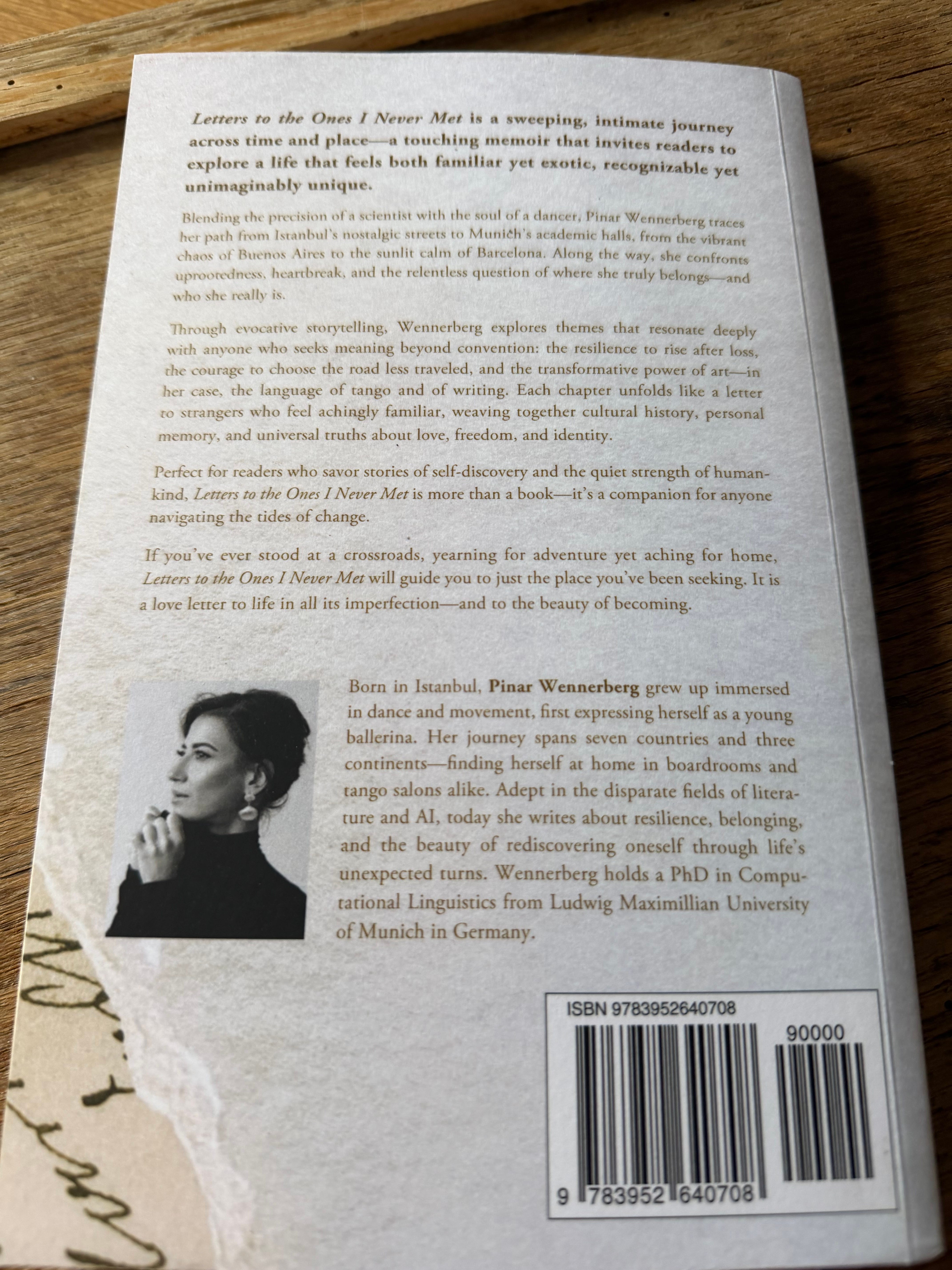
I closed the book and cried for a long time. I had to let it settle. For a while I wanted to forget what it had opened. It was not disappointment. It was recognition. I am writing my own book of memories now, and somewhere in her pages I realized that a chapter of my own life, an interesting one, was over. All of it is behind me now. And life stands there and says: Get up. Forgive yourself. Go and take the world. Run at it. Look at it. Learn it. And on the way, pick up the little girl and carry her; pick up the little boy still sitting inside your own heart. The last page of her book is a photograph of a cupboard at ETH Zurich, Einstein’s cupboard, which people there call the smallest museum in the world. She is wrong about one thing only, and she is wrong beautifully. The smallest museum in the world stands somewhere else. She was seven centimeters too short for the sky, and she has been flying for thirty years, and all this time she has been carrying everything she gathered up there in one small room, and that room is the heart.
Dominic 🦋🦋🦋