

The Strength of the Alibi
On the reasons men give for violence against women - and the silence of the men who watch

August 7, 2026
For a seventeen-year-old girl in Rio de Janeiro.
In January, in Copacabana, she accepted an invitation from a schoolmate and walked into an apartment she should have walked safely out of. What was done to her there I will not rehearse - the police report does that. It was enough to put a country into the streets: in March, on International Women's Day, Brazil marched under her unspoken name. She survived. In her country, in the year 2025 alone, one thousand five hundred and sixty-eight women did not - three times as many as a decade ago. I write her here without a name because I do not know it and must never learn it, and because that is precisely the point: she stands at the head of a line of thousands, on every continent and in every language, suffering in a silence kept safe by the strength of the alibi. May every sentence of this essay be counted as testimony given in her defense - and in the defense of the women no page will ever mention.
And for Anne of Drawn From Silence, whose essay "The silence that follows violence" set this one in motion. It was she who looked at that case and noticed what almost no one else did: the women speaking, and the men not. Her closing has not left me since - "Violence shocks. But the silence surrounding it should too." She writes the way lighthouses work: not to be admired, but so that someone far out on dark water can find the shore. An essay like hers does not request an answer. It leaves a door open and trusts a man to walk through it. This is me, walking through.
I.
I never hit a woman.
For years I carried that sentence like a certificate of decency. It is not a certificate. It is an alibi - the cheapest one men ever wrote for themselves, because it sets the bar at the height of a fist and calls everything beneath it innocence. My father could have signed the same sentence. So, on too many days, could the man I least want to remember being.
A writer I admire asked, in an essay I have not been able to walk past, why it is women who speak about violence against women - while men, who commit almost all of it and witness far more than they admit, keep so carefully quiet. She wrote about the silence that follows violence. I want to write about the other one: the silence that walks ahead of it, clearing the road. I know that silence from the inside. I was raised in it. I inherited it. More than once, I have used it.
This essay is my attempt to answer her question the only way a man honestly can: not as a lawyer for my sex, and not as its prosecutor, but as a witness taking the stand under oath - beginning with the testimony against myself.
II.
The house I grew up in was never struck. No door hid a bruise; no neighbor ever had reason to call anyone. By the standard of the fist, nothing happened there at all.
And yet I spent my boyhood learning the weather of one man's moods the way sailors learn the sky. Quarrels that circled for days without landing. Grievance kept like a fire that must never be allowed to die. The steady, grinding arithmetic of a house where nothing my mother did was ever quite enough, and no one at the table was ever quite safe from being told so. I do not remember a single blow. I remember wanting, from a certain age onward, only one thing: to leave.
At eighteen, I could. University was my open door, and I went through it almost at a run. My mother had no such door. She stayed - with the tyranny of the everyday, with the unpaid work of absorbing a man's displeasure so that her children would absorb less of it. It took me thirty years to understand what I had actually witnessed: that violence is measured not by the force of the blow but by the price of the exit. He never raised a hand. He only made sure that every road out of that house was longer for her than it was for me.
That is the first thing the alibi hides. A man does not need fists to hold a family hostage. He needs only patience, repetition, and a doorway he happens to be standing in.
III.
In my wider family there was another house, where the weather was simpler and worse.
My uncle beat his wife. Not once, not in one bad year - for years, with the calm regularity of a man who has learned that nothing will happen to him. And nothing did. He had the stronger hands, the larger wallet, the better standing; people greeted him warmly in the street. She had a faith that he would change, renewed each time like a prescription, and a price of exit set so high - by his money, by her fear, by everyone's expectations - that staying always cost less by morning. Hope, I learned watching her, can be a jailer too, when hope is the only thing a woman is left to hold. Life afterward was not gentler to her than he had been.
I sat at those family tables as a child, then as a young man. Everyone knew. No one said. The adults had a choreography for it: eyes to the floor, subject changed, coffee poured. I learned the steps long before I understood the dance - which is exactly how it works. A witness learns silence before he learns speech. By the time I had words for what I was seeing, keeping them to myself already felt like good manners. That is the second thing the alibi hides: it takes one man to throw a punch, and a whole quiet room to make it disappear. He was, in the oldest phrase of such houses, a man who was always allowed more. But permission is never taken. It is granted - by every silent witness at the table. And I sat at that table for years.
IV.
Now the hardest testimony, and the shortest.
Once, I pulled my daughter's hair. Hard. There were circumstances, and they were difficult, and they do not matter. That is the entire testimony, because a deed like that deserves no adjectives to hide in. What it left behind is easier to describe: that one moment revoked, for the rest of my life, my license to argue from strength.
I never hit a woman - and here is what that alibi bought me. Cover for the raised voice that made a kitchen smaller. For the cursing. For picking at trifles, for wars declared over nothings - the small denominations of the same currency, minted from the same certainty that my displeasure deserved a public. I hope this is behind me. But a man who has seen what I have seen does not get to say it is behind me and rest. Hope is not a verdict. It is a duty of vigilance, renewed daily.
V.
So why. If I set out to answer her question, I owe it a straight answer - the reasons named without flinching, and disarmed one by one. Because every reason I have ever found is a cause. Not one of them is a justification. A reason is a map of how we got here. It is never a deed to the territory.
The training. A boy learns what a man is allowed by watching what a man gets away with. The constitution of the house is written before he can read: his comfort is law, her effort is furniture. Nobody hands him this permission in words. It is simply never revoked.
The poverty. Watch a small boy: he grieves, he fears, he aches with tenderness. Then watch what the world licenses him to keep. Sadness is shameful, fear is shameful, tenderness is suspect - until anger stands alone, the one emotion with a permit, and everything else must cross the border dressed in its clothes. Strength was the alibi. Poverty was the truth. Fists are what fluency looks like in a language reduced to one word.
The fear. Beneath most of the control I have witnessed sat something almost pitiable: terror. Of insignificance, of being left, of being seen at true size. Control is fear in a pressed suit. This explains much. It excuses nothing - fear is a thing to be treated, not obeyed.
The money. Economic power is the quietest fist. It never touches skin; it only prices every road out of the house beyond reach, then calls her staying a choice. Whoever doubts it is violence should ask why it is guarded so jealously.
The audience. Violence against women is performed for men - for the silent brother, the joking colleague, the friend who changes the subject. Every silent man at the table co-signs the permission slip. I know. I signed for years.
And the excuses promoted from accelerants: alcohol, stress, nerves. Fuel, all of it - never ignition. The proof is old and unanswerable: no man, however drunk, beats his employer. The target is selected. Selection is control. And a control fluent enough to choose whom it may hurt cannot plead helplessness afterward.
VI.
I do not ask forgiveness here - not for my father's house, not for my uncle's hands, not for my own. Forgiveness belongs to the women who would have to grant it, and it is not the point. The point is the debt.
To my mother, who will not read this essay, and who absorbed a man's weather for decades so that her children would feel less of it. To my aunt, whose hope was turned against her like a tool. To my daughters - who owe me nothing in return. To the girl from Copacabana, and to the one thousand five hundred and sixty-eight who did not survive last year in her country alone. And to the writer whose essay I could not walk past: you asked why men stay silent. I no longer have an answer I can live with.
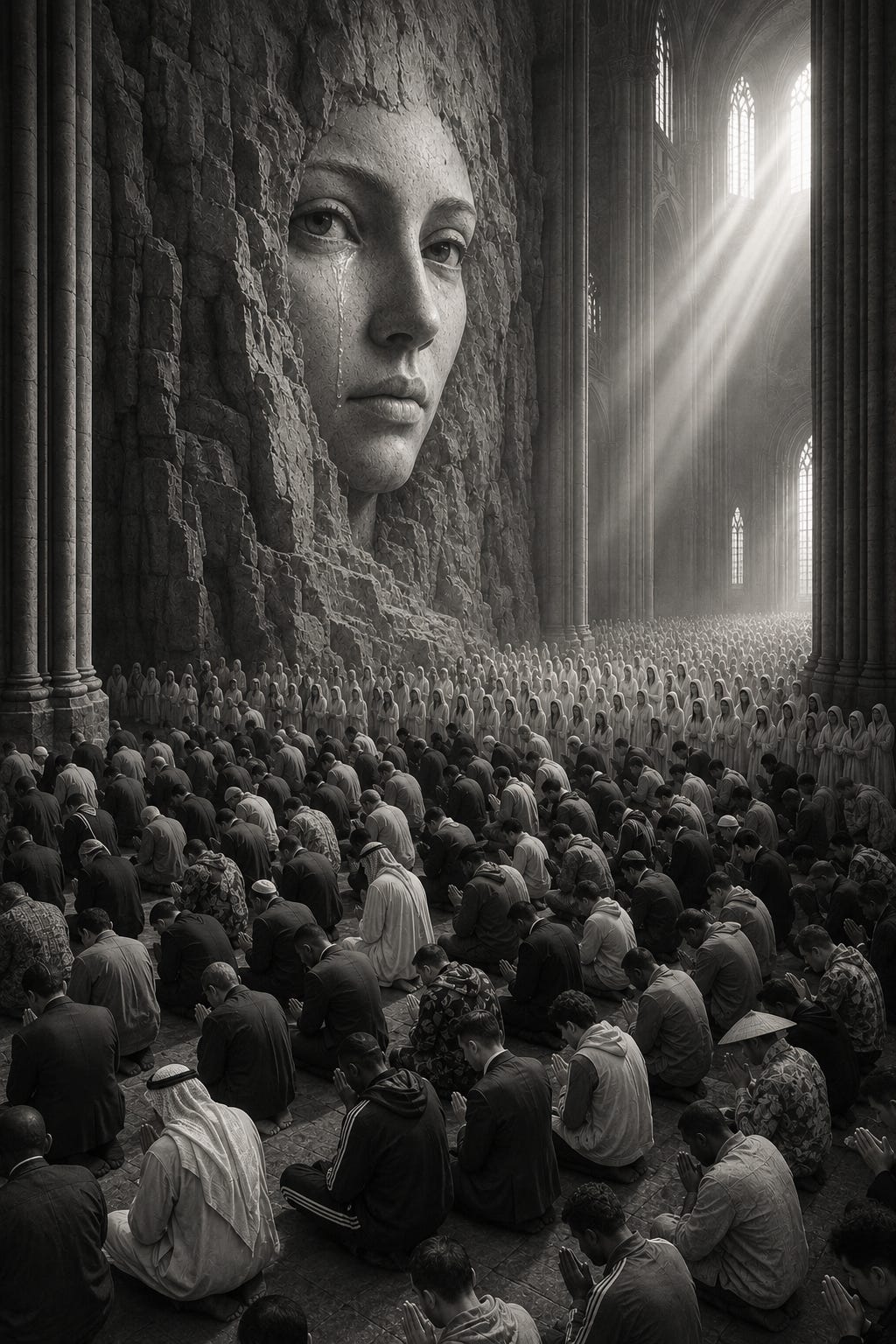
Because I have run out of other ways to say it: the silence of men is not neutrality. It is infrastructure. Every unspoken sentence at every table is a beam in the house where this happens. And the courage that stays silent to keep the peace is not courage at all - it is cowardice with good posture.
She wrote about the silence that follows violence. I have tried, here, to break the one that walks ahead of it.
This essay is not a confession. It is a first installment.